Two-port cabinet
A 2-PON pizza box in a 1U or 2U rack unit often feeds one splitter. Record split ratio, 1:32 or 1:64, and whether the uplink is GE or 10GE. Power over Ethernet does not belong on this line. Confirm -48 VDC or 100-240 VAC instead.
Requirement gateway
LinkScope Sourcing 07 is an independent sourcing partner. A 10g olt price request is usable when the PON standard, port count, wavelength pair, optical budget class, power input, quantity and US destination sit in one brief. The desk then asks plants to quote that written scope. It does not hold chassis inventory and it does not treat a family name as proof that a model fits an existing ONT fleet.
Prepare these cells before supplier search: interface type (PON ports plus uplink), data rate named by standard, wavelength, fiber mode, reach or split, connector, optical budget, diagnostics, temperature range, and host compatibility with the ONT and the management system. Mark unknown cells as open questions. ITU-T G.9807.1 and IEEE 802.3av are question context for 10 Gbit/s PON families. They do not certify any chassis offered later.
Submit an OLT requirement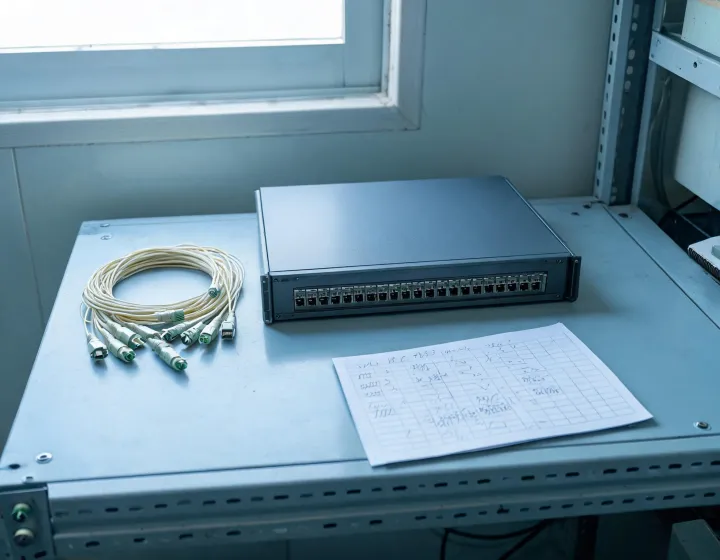
Each row is a question the quoted plant answers for the exact model. A public class name is not a measured result from this desk.
GPON discussion often cites 2.488 Gbit/s downstream and 1.244 Gbit/s upstream. XGS-PON discussion under ITU-T G.9807.1 often cites a nominal 9.95328 Gbit/s each way. 10G-EPON discussion under IEEE 802.3av often cites 10.3125 Gbit/s. Write the standard, not only the words “10G”, because those line rates are not interchangeable on one ONT.
Ask for downstream and upstream wavelengths in nanometres. GPON briefs commonly record 1490 nm down and 1310 nm up. XGS-PON briefs commonly record 1577 nm down and 1270 nm up. Symmetric 10G-EPON discussions also use a 1577 nm / 1270 nm pair, which is why the standard name must travel with the wavelength.
Ask the plant to map the class to decibels on the proposed chassis. Public notes often place GPON class B+ near 28 dB and class C+ near 32 dB, and they name XGS-PON classes such as N1, N2, E1 and E2. Those labels are prompts. The datasheet must give transmit power and receiver sensitivity in dBm for the exact port.
PON access is a single-mode question, commonly G.652.D, not a multimode plant. Record SC/APC or the connector the drawing actually uses. Insertion loss and return loss belong on the patch-cord and splitter sheet. A cord note sometimes discusses return loss near 60 dB and mated-pair insertion loss below 0.3 dB. That cord sheet is separate from the chassis price.
List OMCI, DBA, FEC and whether AES is required. Name the ONT models already in the field, the EMS or local CLI, and whether dying-gasp and per-port optical power readouts are mandatory. A matching “10G” label does not prove the ONT will range.
Buyer scenario, not a published job. A municipal access planner had 64 ONTs on a 1:32 split that were already GPON. The brief kept GPON as the mandatory line and listed an XGS-PON card as an alternative with its own wavelength pair. Two plants then quoted the same port count, the same SC/APC face and the same -48 VDC input, and they marked XGS as optional. The result was a comparable pair of quotations instead of two unlike chassis sharing one headline price.
A 2-PON pizza box in a 1U or 2U rack unit often feeds one splitter. Record split ratio, 1:32 or 1:64, and whether the uplink is GE or 10GE. Power over Ethernet does not belong on this line. Confirm -48 VDC or 100-240 VAC instead.
Count living units, spare PON ports and the existing ONT vendor. Temperature questions often start at 0 °C to 50 °C for an indoor room. If the room is unconditioned, ask the plant for the actual range rather than copying an outdoor figure.
An 8-port or 16-port modular shelf changes fan trays, switching capacity of the uplink fabric, and software scope. Ask whether the management license is in the chassis price. Keep calibration traceability with the plant test report, not with this page.
Ask for ingress protection of the enclosure and a temperature range. Outdoor notes often cite about -40 °C to 65 °C. That range is a question, not a rating this desk measured. Separate the cabinet from the OLT if they are different suppliers.
One side of this choice: the PON face is single-mode because subscriber fiber, splitter loss and optical budget are planned on G.652 plant. The other side: a short headend jumper sometimes uses a multimode SFP on a separate Ethernet uplink. Those optics do not share a wavelength plan. Write them on different lines so a plant cannot price one cage as if it served the splitter.
Read the procurement brief, then open the inquiry rows.
Ask whether PON optics, uplink optics, power shelves, fan trays and the EMS license are included. A unit price that omits a 10GE SFP+ is not comparable with a price that includes it. State quantity as chassis, and state a separate quantity for spare optics if you need them.
Record currency, per-chassis or whole-order basis, Incoterm, freight, duties and whether the date is for a sample or for the production lot. An optional target budget uses the same currency and the same basis. It is a buyer note, not a price from this desk.
New equipment can make license and support easier to trace. Refurbished equipment can be the only route for a legacy control card, but only after condition, remaining entitlement and warranty are written on that serialised item. Do not let one column mix both conditions.
Define document review, incoming power-up, optical power readout and a management login. Measurement accuracy of the port monitor is a plant claim tied to the model. This desk does not issue a calibration certificate.
Send the standard name, port count, wavelength, optical budget class, power, quantity and US destination. Plants reply on that sheet. LinkScope Sourcing 07 coordinates the comparison. The benefit banner states FREE sourcing support and a ceiling of up to 3% for qualified business buyers after the brief is reviewed.
A second buyer scenario: a regional operator needed four 2-port chassis for cabinets that already had -48 VDC. The brief froze power, SC/APC and a 1:64 split, and it left the EMS license as a priced option. The result was four quotations that could be added without hiding a license inside one of them.
Qualified business buyers
Compare factory wholesale quotations on one OLT specification.
FREE review of the written product, quantity, destination and sourcing requirements
Eligible orders may receive a benefit of up to 3%
Eligibility applies to qualified business buyers and is confirmed after we review your product, quantity, destination, and sourcing requirements.