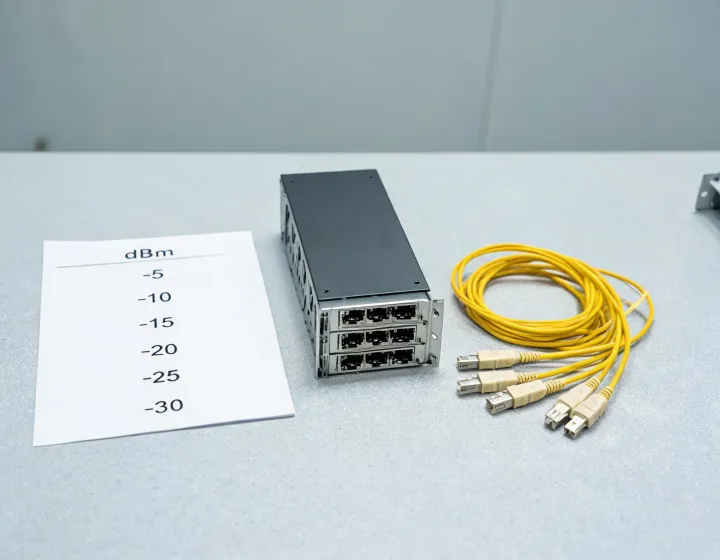
Interface cards: what still has to be filled
Downstream wavelength and launch
Ask for the downstream wavelength in nanometres and the transmit power in dBm at the stated temperature. A card that says 1577 nm still needs the launch window. Dispersion penalties, if the plant quotes a long reach, belong in that same note with the fiber type.
Upstream wavelength and sensitivity
Ask for the upstream wavelength and the receiver sensitivity in dBm. Optical budget in dB is the span between the launch you can rely on and the sensitivity, after the plant’s own margins. Do not subtract splitter loss yourself and call the result a class.
Pluggable versus fixed optics
An SFP+ PON optic can be a separate SKU from the chassis. Record whether the cage is empty. Insertion loss of an extra adapter, if the face uses one, is an adapter question. Return loss still sits on the connector grade, commonly SC/APC when the plant drawing says so.
Management and encryption
Write whether OMCI, DBA, FEC and AES are mandatory. A local CLI and a licensed EMS are different products. Switching capacity matters when the uplink fabric, not the PON port, is the limit. State the uplink rate beside it.
OEM-coded optics versus a compatible optic in the same cage
Side A, OEM-coded: the optic is the one the chassis vendor names, which can make support conversations shorter when a port will not range. Side B, compatible: another optic may be sourced when the exact host, wavelength and firmware policy are checked, and it may be the only part available for a discontinued cage. Neither side is chosen on this page. The brief records which policy you are buying, and the plant states the coding behaviour of the proposed optic. A photo of an SFP+ latch is not that statement.
Managed EMS versus a fixed local configuration
Side A, managed: an EMS seat gives alarms, optical power trends and remote provisioning when the license and the network path exist. Side B, local only: a closet chassis with a console cable can be enough for a two-port site, and it avoids a yearly seat, but it also means truck rolls for changes. Managed versus unmanaged is a real split here even though an OLT is not an Ethernet desktop switch. Put the license in or out of the hardware price on purpose.
Buyer scenario. Background: a buyer was offered a “10G” substitute after the specified XGS chassis slipped. Process: the checklist required the substitute to state 9.95328 Gbit/s versus 10.3125 Gbit/s, the ONT models, FEC, and whether AES was on. Result: the substitute was 10G-EPON and the installed ONTs were XGS, so the offer stayed in the alternative column instead of replacing the line.
Another scenario. Background: the optic was missing from a chassis quote. Process: the buyer asked for transmit power, receiver sensitivity and whether the SFP+ was included. Result: the revised quote added a separate optic line at a stated wavelength, and the chassis price stopped pretending the cage was loaded.
Open the inquiry rows when the open cells are listed, then send the evidence list.